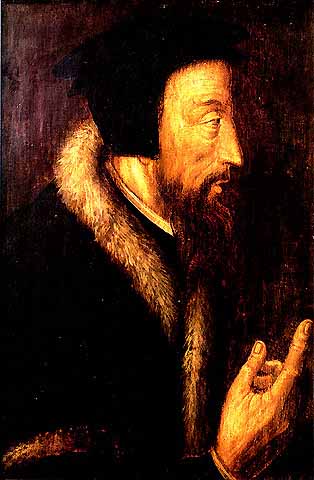
The
young French student trained in law and stoic philosophy who fled Paris in 1534
because of his links with supporters of the Reformation, and a few years later found
himself called to Geneva, has had an extraordinary impact on our history and identity.
In the midst of the fierce religious debates and political
conflicts of that era, he sharpened his understanding of what Christians should
believe, how they should live in a worshipping community of ordered ministry and
discipline, and how a Christian vision should impact a Christian society.
Through his pastoral leadership, his writings in Latin and
French, and by the influence of refugees from Britain and Europe who came to experience
in Geneva what Knox called the most perfect School of Christ since the Apostles,
Calvin's ideas and example took root as a major stream of Protestant Christianity
alongside Lutherans and Anglicans. Even for Presbyterians in 21st century
New Zealand, many cultures and diverse experiences of faith later, it is difficult
to understand ourselves without reference to Calvin. From early on Calvin became
the centre of an international movement. For many Reformed Protestants being refugees
and migrants became a part of their identity, chosen like the children of Israel,
seeking God's presence and promises in alien contexts, living by their faith and
their wits to make a world for their descendants that would bring glory to God.
Calvin's theology still provides us with the enduring framework
of Presbyterian and Reformed theology and practice. People debate his personality
and some of his decisions and not all find it easy to allow him to be a person of
his time and place. The systematic clarity of his theology continues to inspire
and impress, and possibly also seduce. There really are those who find it difficult
to believe there could be anything significant about God Calvin did not map out.
However if we see Calvin as a source of wisdom, not of infallibility, and as the
writer of sermons and commentaries, as well as the famous Institutes of the Christian
Religion, it may be easier to learn from him without seeing it as a hugely big deal
if we think differently on some issues.
Life and influence
Calvin was born at Noyon
in France 10 July 1509, studied arts in Paris from 1522 to about 1526 and law at
Orléans and Bourges until 1531. In 1532 he published a commentary on the writings
of the Stoic philosopher, Seneca. By 1533 he had become associated with the Reformed
cause and dedicated himself to the writing of theology. In October 1534 Protestants
in Paris placed posters around the city and Calvin felt it advisable to leave.
In Basle in 1536 he published
in Latin the first edition of his Institutes of the Christian Religion.
Passing through Geneva in July that year he was compelled by William Farel to join
in the task of establishing the Reformation there. They moved too fast and in 1538
were banished. Calvin went to Strasbourg, sat at the feet of Martin Bucer, and pastored
a French Congregation. In 1541 he was recalled to Geneva where he remained until
his death in 1564. Through hosting refugees and the influence of his Academie on
pastors returning to their own countries his ideas spread.
2009 marks the 500th birth of John Calvin. See
Calvin 2009.
Calvin and Calvinism
It is necessary to distinguish Calvin from Calvinism. Calvinism
is not just the summary of his teachings, it is their interpretation by subsequent
generations.
Every generation in the Reformed churches since Calvin has
responded both to Calvin's own teachings, and to the theology of Calvinist teachers
since. Hence although the word Calvinism continues to refer to how Calvin's teaching
is interpreted, that can be expected to change over time and place. It is sometimes
informed by revisiting Calvin's own life and writings. It is sometimes a reflection
of later theological debates. We interact with the layers of interpretation as well
as the source - as we do with the teachings of Jesus.
Caution is needed about reading back successive Calvinisms
into Calvin himself. Later teaching may tell us something about Calvin that has
been missed or misunderstood, but it may not. It will always be to some extent about
issues in its own time and context. Some arguments with Calvinism are arguments
with Calvinists not with Calvin.
For instance the decisions of the Synod of Dort in 1619 (often
referred to as TULIP) are Calvinist in influence, but should
not be attributed to Calvin himself. Likewise the Westminster Confession of 1646.
Each of these take Calvin's ideas and address contemporary issues. We cannot understand
them properly apart from their historical context. We should not say Calvin taught
something just because we like or do not like something in Dort or Westminster.
The Evangelical leader Thomas Chalmers (1780-1847) was selective
in what he took from both Calvin and from the Confession, yet considered himself
true to both. The word Calvinism in his time refers more to Scottish interpretations
of Dort and Westminster than to Calvin himself. Although Chalmers' theology teacher,
George Hill, recommended reading Calvin directly, Chalmers like others tended to
interact with the issues of his own day. In a era becoming interested in mission
overseas and aware of the need for mission among an emerging working class, he retained
the vision properly but not uniquely attributable to Calvin that Christian faith
should apply to the whole of society. He regarded the word Calvinism as applying
to theologies of election and predestination which might inhibit making a universal
offer of the Gospel to all who might respond - things he regarded it as God's business
- ours was to preach the Gospel.
Even though for the 500th anniversary of Calvin's birthday
in 2009 there has been an enormous effort made to correct popular misunderstandings
about Calvin, it too can be expected to be shaped by contemporary concerns. Some
of this may be detected in the video clips above.
Modern Calvinists are often concerned that words like gloomy,
strict, unreconstructed, narrow, severe - all spectres of a religion the un-named
enlightened "we" do not like, are still commonly linked to Calvinism without apology
(see the piece
Why won't Calvin die? in the Guardian for instance).
Contemporary Calvinists can be expected to suggest that Calvin
should not be blamed for being a person of his own time, and the things about Calvin
which are difficult for some today (eg his role in the execution of the anti-trinitarian Servitus and
in the formulation and enforcement of an intrusive moral code in Geneva and its
export to Scotland) should be played down as common features of 16th century European
life. It will be recalled how Calvin contributed to education, business and democratic
values because these are valued today. We are likely to hear that Calvin is both
a champion of religious freedom and an example of God-sanctioned oppression.
All of us reflect our own times and circumstances as well as
the views of the people we draw on. No generation is infallible in its interpretation
of Calvin, and each generation will have its own perspectives and questions on his
interpretation of what it was to be a faithful Christian minister. It may be that
in his method and values, and the questions his faith raised which our times find
hard to hear, God's Spirit may still speak to us. That rather than any notions of
infallibility for him or for us, may be where his greatest influence still lies.
Humour:
There may be some surprises in the Dutch newspaper quiz "How
Calvinist are you?"Trouw
Huck Finn in the late 19th century:
"It was pretty ornery preaching -- all about brotherly
love, and such-like tiresomeness; but everybody said it was a good sermon, and
they all talked it over going home, and had such a powerful lot to say about
faith and good works and free grace and preforeordestination, and I don't know
what all, that it did seem to me to be one of the roughest Sundays I had run
across yet."
(Huck Finn in Mark Twain, Huckleberry Finn, quoted by Hart, D G and Mark A Noll,
Dictionary of the Presbyterian & Reformed Tradition
in America, IVP, 1999, p.xv.)
Whether Calvin
and Hobbes also tells us something about theology and philosophy and Reformed
identity might also be worth a conversation!
Notes
TULIP : Total
depravity; Unconditional election; Limited atonement;
Irresistible grace; Perseverance of the saints.
Other pieces from the Guardian relating to Calvin's 500th were more balanced:
Calvin and the limits of earthly power,
People power in Geneva. Catholic appreciation of Calvin is generally nuanced,
but it was interesting to read of a tendency for some in the Vatican to characterise
"What is wrong with America, including its Catholics" as its Calvinism. See
Word from Rome December
14, 2001 and
May 23, 2003. The main features are individualism, a lack of sense of community,
and a weak doctrine of Grace leading to harsh and unforgiving attitudes.
 The
young French student trained in law and stoic philosophy who fled Paris in 1534
because of his links with supporters of the Reformation, and a few years later found
himself called to Geneva, has had an extraordinary impact on our history and identity.
The
young French student trained in law and stoic philosophy who fled Paris in 1534
because of his links with supporters of the Reformation, and a few years later found
himself called to Geneva, has had an extraordinary impact on our history and identity.