Thinking about Christian mission
-
Mission asks why we are here as a church.
The writers of the Westminster Shorter Catechism asked "What is the chief end of
man" and said it was to glorify God and enjoy him for ever. We might ask "What is our purpose?"
and say that talk about Christian mission usually refers to the purpose of the church outside of itself
and how that is deeply rooted in who we are in Christ.
-
Theology helps us talk about what God is
like. It refers to our understanding of God as discovered in
our cultures and across cultures through our worship of God, our reading of the
Scriptures and our engagement in mission. Theology is tested by comparison with
the understanding of other Christians in different times and cultures.
-
Missiology is theology thinking about
the purpose of the church. Missiology starts with thinking theologically about the mission of God and the
purpose of the Church outside of itself.
As
such it is part of theology and a dimension of ecclesiology. Since Christian Mission is directed
towards the world missiology is also concerned with culture and with people of other faiths.
Andrew Walls has said that "missiology is theology that takes culture
seriously"
-
Worship
is about acknowledging God and seeking his help and direction. We seek
Jesus and ask him to teach us to pray. Worship inspires mission and engagement in mission drives us to
prayer and worship.
What we are about
The Church is about worship and about mission and about being
a sign of the presence and the coming of the Kingdom of God.
We seek to be a worshipping community that nurtures faith, a
faithful community that stimulates mission, and a missionary community that is
rooted in worship.
In music and word, poetry and movement, art and action, we
come just as we are as we also strive to offer the best that we can be.
In home and community, workplace and church, we serve others
through being true to ourselves, claiming God’s promise to do more than we can
ask or think.
The church exists to call people to worship God, to follow
Jesus Christ, and to make him known, to make it possible for people to know that
God is with us.
We recognise the authority of the Word of God over the church
and the world, and our responsibility to discern, obey and proclaim that Word.
We bear witness to the grace of God in Jesus Christ and to the
gift and gifts of the Holy Spirit.
We are thankful for the goodness of creation and acknowledge
our responsibility to respect its integrity and to share its gifts.
In this land of beauty and uncertainty, of living covenants
and broken promises, of renewed hope and slow justice, of open spaces and
shifting values, we would seek Jesus, and ask that he teach us to pray.
We want to live lives that make it more easy and not more
difficult for others to believe in God.
Not for ourselves only do we seek to build communities that
make it possible to live the Christian life.
We want to seek and to share truth, to encourage faithfulness,
to facilitate a sense of wonder, to stir curiosity for the things of God and of
creation, and never to lose our respect for wisdom.
We acknowledge our inability to be all things to all people,
but we aim to be a safe place for lovers and children, for the elderly and the
awkward, for the hurt and the handicapped, for the different and the simple, for
friends and the friendless, for those who have found success, and those for whom
there is no place to rest. Without one another we are incomplete in Christ.
We recognise our responsibility to respect the cultures of our
heritage, to affirm what is good, and to challenge all that makes people less
than human.
We confess that we see justice in different ways, and perceive
paths to peace through different routes. We struggle with the burden of
discernment through prayer, study and debate. We acknowledge the pain of change
and the cost of renewal.
In every age the Scriptures speak with fresh relevance. We
join the prayers of the Psalms with the passions and anxieties of our lives. We
share the wanderings, faith and failures of the people of Israel. We respect the
profundity and example of Paul. We hear Jesus’ promises in the beatitudes, his
challenge in the Sermon on the Mount and his humour and seriousness in the
parables.
In communion we share memories of his life, death and rising
again. Like the first disciples we worship even as some of us have doubts, and
also like the first disciples we accept his call to go, to baptise and to teach.
We recognise Jesus’ authority and claim the promise of his
presence. We pray that the Spirit of the Lord, which came upon him, may also be
upon us, to bring good news to the poor, liberty to captives, sight to the
blind, and to inspire words and deeds which say that the time has come when the
Lord will save his people.
The men and women who brought us to this land also shape us.
We recall with nostalgia and respect heroes of conviction, the struggles of
ordinary life and stories of costly faith.
May we learn from their failings as from their success, and
imitate their faith not their foolishness. May we too take risks to find pearls
of great price.
Help us also to love the Lord our God with all our heart, with
all our soul, with all our mind, and with all our strength, and our neighbour as
ourselves.
A sustainable commitment
If missiology
is to go on helping the church in different circumstances be confident about
what it is doing it needs both a modest and a strong place among its
fellow theological disciplines:
It needs to be modest in that while
missiologists may be champions of the mission of the church they are not its
owners. Other theological specialities, and the faith of church leaders and
Christians generally are stakeholders in determining and obeying the
mission of the church in particular times and places. Missiologists may help
provide the tools, but they are but partners in the exercise.
It needs to be
strong since missiologists have things to say that those with less
experience in mission across and within cultures are less likely to say. Their place in the church, and in the training of the church's leaders needs to
be assured. Left to themselves other disciplines do not always appreciate
the learnings that lie in the story of the church's mission, or the importance
of cultures other than one's own for understanding what it is about.
While sustainability is
no infallible indicator of truth, if a particular vision of mission is not
sustainable for a Christian community it at least raises questions about whether
the fundamentals are right or not. The history of churches and mission societies
that have tried to make mission the sole reason for their existence does not
lead me to believe that such an emphasis, however sincere and worthy, is in fact
sustainable. Indeed by its neglect of worship and failure to address the demands
of community it may in fact be theologically suspect as well as socially
impracticable.
Thinking about God, the Church and the world
1) A triangle of
relationships
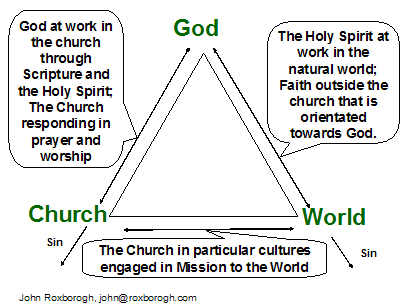
We cannot understand what is required of the Church towards the World,
or understand the importance of culture for the Church,
without taking into account what is going on between God and the World, the
World and God, and between God and the Church.
2) Worship, Community and Mission are fundamental dimensions of the
Church's life:
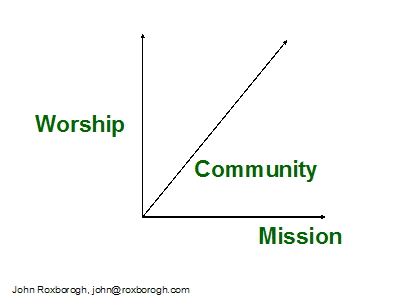
Lists of the
fundamental dimensions which constitute church are
often
longer than this, and the categories
identified often do not have a hierarchy of relationship though many want to
place mission at the top. I prefer to think of these three dimensions as primary
and then thinking what they mean and what else they involve indifferent
situations.
The three do of course interrelate and particular elements such as leadership
appear across the three.
This linking of Worship, Mission and Community arose for me out of reflection
about the core dimensions of the purpose of the church, and somewhat rarely also appear elsewhere. Writings that I have come across include
the Mennonite Board of Congregational
Ministries, A three fold vision for worship, community and mission, Herald
Press, 1997, and in Daniel Schipani, "The Church and its Theological Education:
A Vision" in Nancy Heiser and Daniel S. Schipani. Theological education on
five continents : Anabaptist perspectives, Occasional papers (Institute of
Mennonite Studies (Elkhart, Ind.). Strasbourg, France: Mennonite World
Conference, 1997, pp.14-21. The phrase also appears in Grace Wenger, Witness:
empowering the church through worship, community, and mission. Scottdale, Pa.:
Herald Press, 1989. A similar concern can be found in
John Piper, Let the nations be glad, Baker, 2003
3) Working
with others to explore the issues of today.
Christians and churches
participating in debate about ethics, ecology, economics, globalisation and
politics and bringing their faith to these conversations has a theological basis
in our faith in the Lordship of Christ over the whole of life. Christians do not
need to be afraid of growing in and sharing what it is to follow Jesus Christ
through dialogue with other people in their understanding what the Bible means
and what Jesus is about.
Saying less, achieving more?
I have
often had a polite but bewildered reception to these ideas - the primacy of
mission in ecclesiology is considered so theologically self-evident that it
seems ridiculous to suggest otherwise. And of course in a very simple sense, to
the point of being a tautology, the mission of the church is mission - but that
lies in the meaning of words not in the purposes of God. Yet I continue to believe that discourse
about mission which shifts from saying the church has a missionary dimension to
saying mission is what the church is all about is actually a theological,
pastoral and strategic mistake.
It may be
against the grain for to say that less is more as far as the promotion
of mission is concerned, but I think actually think it is. Whatever our rhetoric
about being missional the actual life of the church properly involves a balanced
commitment to our worship, our community life and our purpose or mission outside
of ourselves. There is no point in trying to make mission the key to the others
and there is in my view some danger. However I
acknowledge I need to work at how to present this material more adequately,
including theologically.
People are tired of being told to be missional or missionary
when their need is to be renewed in their love of God. Perhaps Augustine was
right in saying "love God and do as you like." It could be the great release of
the grace of God we need to hear. We might just find, as has often been the case
that spiritual renewal that avoids the temptation of selfishness will also lead
to the renewal of mission. It is faith not harangues which revives our
connection with the work of God in the world. I see calls to mission running out of steam and people
discovered the need for a grounding in spirituality if they are to be able
sustain their own interest and the interest of others. If some churches are
dead in their liturgies then the answer is not to say "rise up and be
missionary because that is your identity" it is to say "renew your liturgy and
in that you will find your power for mission."
Talk about mission often shades into concern to save the
church more than save the world, perhaps it is in a proper attention to "saving"
our worship and our life together that we may be in fact able to do a bit more
in the wider mission of God.
If you have thoughts on these issues
please email me on john@roxborogh.com
John Roxborogh 30 November 2010
Links:
-
Thinking about syncretism and contextualisation
Syncretism may not be our idea of a good outcome but it is a necessary
process if conversion is to actually happen.
-
Lay
Leadership and Ministry and the Future of Reformed Christianity in the West,
2002.
-
A Theology of Mission for the Presbyterian Church of
Aotearoa New Zealand, 2002 (earlier version
of what is above).
-
Thoughts on theology today
(May 2002) (Word)
-
Biblical Studies and Mission Studies
ANZABS
paper, December 2001
(incorporates
Revisiting the Missionary Nature
of the Old Testament)
-
After
Bosch: The Future of Missiology (Word)
Princeton Currents in World
Christianity Seminar, 2 February 2001
-
Is “mission” our only mission
- Revisiting the Missionary Nature of the Church,
ANZAMS paper, 28
November 2000
-
Revisiting the Missionary Nature
of the Old Testament ANZAMS paper, November 2001.
-
Preaching about Work
(The Preacher, Quarterly Publication of the New Zealand Lay
Preacher’s Association, June 2001, pp.19-22)
-
Chaos, Order and the Democratisation of the Holy Spirit,
Inaugural Lecture, Presbyterian School of Ministry, Knox College Dunedin, 21
February, 2000. (PDF)
-
Biblical
Theology of Mission (1999 Bibliography, Word)
-
Mission Conferences
(1999 Bibliography, Word)
-
Mission Issues
(1999 Bibliography, Word)